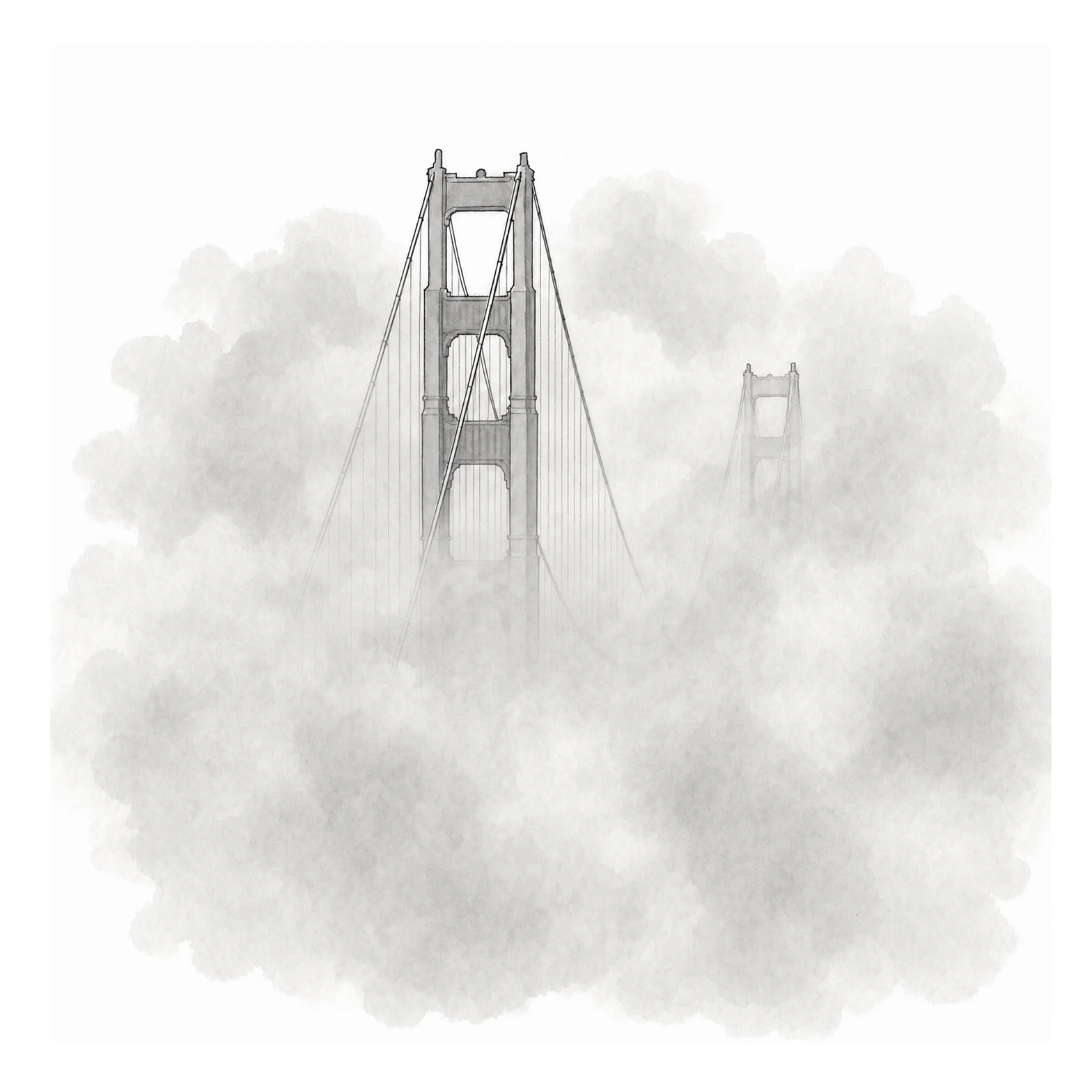
From fog to form
A method for turning vague worries into something you can name, define and test.
The complete, practical method. Fifteen minutes of reading. By the end, you should be able to apply it to something of your own, today.
There are two kinds of problems in your life. Those with a shape, and those without one.
Problems with a shape can be tackled: a bill to pay, a flight to book, a bug to fix. They are annoying, but not frightening. You know where they begin, roughly where they end, and what solving them would look like.
Problems without a shape are different. “I don’t know where my career is going.” “Something isn’t working in this relationship.” “I need to grow the business and don’t know how.” “I should take better care of myself.” They are not problems yet. They are fog. They have no edges, so they have no size; and anything without a size tends toward infinity. That is why a small patch of fog can weigh more than ten big problems: you cannot measure it, only feel it. And because you cannot tackle it, you circle around it. For months. Sometimes years.
This method does one thing: it turns fog into objects. An object is something with a name and edges, something you can point to, measure, break apart and move. The method does not solve the object. That comes later, and sometimes it does not come at all. What it does is something earlier and rarer: it gives you back the ability to look at it without running away.
It also produces a side effect that is the real reason to use it: calm arrives when something has edges, not when it has been resolved. Think about it and you have already experienced this: the relief of specific bad news compared with the anxiety of vague uncertainty. A diagnosis reassures you before treatment begins. A fixed quote reassures you before the work is done. A difficult conversation you have already had, even if it went badly, weighs less than the conversation still waiting to happen.
This is not just an impression. Research points in that direction. Studies of affect labeling by Lieberman and colleagues at UCLA show that putting an emotional state into words reduces activity in the amygdala, the part of the brain that sounds the alarm. Naming literally turns down the volume of fear. Take that as support, not dogma, but it matches what you may feel when you carry out step three.
Before it has a name, fog does not exist as something you can work with. It exists as a feeling: a weight when you wake up, a particular reluctance, a subject you avoid. You cannot work with a sensation. You can work with an object.
The passage from sensation to object moves through four states, always in the same order:



Something is weighing on me. It fills the space because I cannot yet say what it is.
Each state has its own emotion: vertigo, relief, calm and action. Notice that calm appears in the third state, before you have done anything. That is the method’s entire thesis.
The action that makes this passage possible has four steps and fits into five minutes. What follows explains each step, its rules, common mistakes and examples. Read it all once, then try it with paper in front of you.
Do not start with the biggest one. Start with something you have been circling for a while: the thought that appears just before sleep, the subject you change when it comes up, the thing you have spent three Mondays saying you will do this week.
Here is a way to choose: if the thought of writing it down makes you disproportionately reluctant, that is the one. The reluctance is the fog defending itself.
Just one. This method works on one thing at a time.
Write one sentence about what is weighing on you. On paper or anywhere else, but write it down: your mind plays tricks; paper does not.
Three rules:
Be honest, not polished.
“I’m worried about money” is enough. Write what you feel, even if it sounds clumsy.
Name the problem before solving it.
“I feel bad about my body and avoid it” names the weight. “I need to exercise” skips straight to a solution.
Leave out the backstory.
No history, explanations or blame. Just one sentence about what weighs on you.
How to tell whether you have done it well: reading it gives you a small, clean discomfort, like someone telling you the truth. If you feel nothing, you have written a token sentence. Try again.
Give it a name of two or three words. A name, not a description.
The difference matters. A description explains; a name points. “The fact that I’ve spent eight months putting off a conversation with my partner about the equity split” is a description: long, vague and impossible to remember. “The pending conversation” is a name: short, solid, something you can point to. From now on, you can say “today is for the pending conversation,” and your mind knows exactly what you mean.
What makes a good name:
- You can point to it.
- It is yours.
- Nobody else needs to understand it. “The empty Sunday” may mean nothing to someone else and everything to you.
- It does not contain the solution.
- “Going to the gym” is not a name for fog. It is a task in disguise. The fog underneath might be called “the neglected body.”
- It is not an insult.
- “I’m a disaster with money” is not a name. It is a judgment, and judgments paralyze. “The unexamined finances” names the same thing without condemning you.
Something curious happens when you name it, and it is worth knowing: you start seeing the object everywhere. It is the same effect as buying a car and suddenly noticing that model on every street. They were always there; now your attention has a handle to hold. Fog works the same way: you name “the stalled yes” and discover three examples in your week.
This is where fog becomes an object, and where calm arrives. Three questions, in writing:
a) What is it? One or two sentences. “The pending conversation is talking to my partner about the equity split before the end of the month.”
b) What is it NOT? This matters just as much, or more. The fog grew because it absorbed everything; an edge limits its appetite. “It is NOT renegotiating our entire relationship. It is NOT deciding whether I stay in the company. It is NOT resolving ten years of history.”
c) What is outside the scope today? The word “today” is the method’s release valve. You are not giving anything up forever. You are deciding that, for now, it is not your problem. “Outside the scope today: what happens if they say no. That can become another object, if necessary.”
When you have answered all three questions, pause and notice what happened. The object is no longer infinite. It has a size, usually much smaller than the shadow it cast. Most of the time, the physical response is a sigh. That is the amygdala quieting down. You have not solved anything yet, and you already feel calmer: you have just tested the thesis in your own body.
Two cautions:
Write down the cheapest possible version of a first encounter with the object. Three criteria, all required:
It fits into tomorrow. Not next week: tomorrow. If it does not fit into one day, it is too big. Break it down.
The experiment does not exist to solve the object. It exists to answer a question about it. “Is it as serious as it seems?” “Is my partner as closed off as I think?” “Do I really not have an hour a day?” A prototype is a question dressed as an action.
Examples of a cheap experiment: not “have the conversation,” but send a message suggesting coffee next week. Not “fix my finances,” but open the account and look at the numbers for fifteen minutes without deciding anything. Not “get back into exercise,” but walk for thirty minutes tomorrow and see how you feel. Ridiculously small on purpose: the first experiment’s job is not to make progress. It is to show you that you can touch the object without getting bitten.
The experiment returns information, and information is not a judgment. The world is not expressing an opinion about you. It is responding to what you did. With that response in front of you, choose one of two things:
- Refine
- the object was named well and the direction is right. Design the next experiment, a little less cheaply.
- Rename
- the response showed you that the problem was something else. Return to step two without drama. What you invested does not get a vote. Only what you learned does.
Then begin again. This is a loop, not a line: see, name, define the edges, test, then look again.
To show the whole action in real situations, here are three patches of fog from three different parts of life.
A work problem.
- See
- “I need to grow the business, I don’t know where to start, and I’ve been stuck here for months.”
- Name
- the growth question.
- Edges
- It is about understanding the three possible channels for finding customers and choosing one to test this quarter. It is not about becoming a marketing expert, hiring anyone yet or redoing the brand. Outside the scope today: anything that begins with “we should also.”
- Test
- tomorrow, a twenty-minute call with someone who already sells something similar, with one question: “Where do your customers really come from?”
- Read the response
- if the call reveals a clear channel, refine by designing an experiment for that channel. If it reveals that the problem is pricing rather than the channel, rename: the fog had a different name.
A personal project.
- See
- “My portfolio has been half-finished for a year, and I feel ashamed every time I think about it.”
- Name
- the unfinished project.
- Edges
- It is about deciding what “finished” means and getting there or letting it go. It is not about making the best portfolio of my life. Outside the scope today: redesigning it from scratch or learning a new tool.
- Test
- tomorrow, fifteen minutes to write a three-line definition of “finished.” For example: five projects, a bio, published, even if imperfect. Nothing else.
- Read the response
- if the definition fits into two weekends, refine by making a schedule. If writing it reveals that you do not want that portfolio, the fog was something else: perhaps “the outdated showcase.” Rename it. Letting go is also a way to finish.
An emotional problem.
- See
- “Something has felt strange with my sister since the summer, and we keep letting it slide.”
- Name
- the new distance.
- Edges
- It is about finding out whether she is hurt by something specific or we are simply both busy. It is not about resolving our entire relationship or deciding who was at fault. Outside the scope today: grievances accumulated over the years.
- Test
- tomorrow, a two-line message without an agenda: “I miss you. Can I call you on Thursday?”
- Read the response
- the reply, or its absence, is information, not a verdict. Use it to refine or rename. And pay attention: this is where the method meets its limits, which come next.
A method you can trust admits where it ends. This one ends in three places.
Not everything needs a name. Some things are damaged by giving them edges: grief while it hurts, love while it grows, a good afternoon that needs no purpose. If you feel the urge to turn something into an object when it simply needs to be lived, let it go. Overdesigning your life is the most elegant cage there is.
Chosen ambiguity is not fog. Some uncertainties are ones you decide to inhabit: not yet knowing where you will live, not labeling a relationship yet, not defining who you will be in five years. From the outside, they can look like avoidance. From the inside, they are the opposite, because they have an edge: you chose them. If you want, write down that one edge: “I am leaving this unnamed, and that is my choice.” That, too, is an act of naming.
The method does not replace help. If a patch of fog has been there for years and is eating into your sleep or health, naming it is a good first step and a bad last one. A therapist, a doctor, a lawyer or a good friend is sometimes the right small experiment.
The action takes five minutes. The habit takes a few weeks. Three suggestions:
One patch of fog a week. Do not attempt a complete clear-out on the first day. You will exhaust yourself and return to the fog with new reasons. One a week is a pace you can sustain, and in three months you will have turned the twelve heaviest ones into objects.
Keep a list of open questions. A piece of paper or a note containing the names, just the names, of your open objects. It does two things: what you can list, you can prioritize; and you will see that the list is not infinite. Almost nobody has more than ten. Anxiety said there were a thousand.
Measure by sleep, not results. The sign that the method works is not that you solve things faster. It is that unresolved things weigh differently. You sleep better with ten named objects than with three unnamed patches of fog. If that is happening, it is working, even if nothing has been closed yet.
It does not promise that you will solve what frightens you. It does not promise success, permanent order or a life without fog. As long as you are alive, more will arrive, and some will return under another name.
It promises something smaller and testable: the next time something shapeless weighs on you, you will know exactly what to do in the first five minutes. Write it in one sentence. Give it a name. Define its edges. Design the cheapest experiment. And the calm you have spent so long pursuing directly will appear on its own in the third step, as a shadow appears when you place an object in the sun.
Now close this and do it. You have had a patch of fog in mind since the third section. You know it. Paper, one sentence, five minutes.